
Disha ShahBrand & Experience Designer; Founder - Vanya Studio
The SEO Stack I’d Choose for a 2–3 Person Growth Team—with Costs, Weekly Workflows, and What I’d Skip
What I’d buy for about $129 a month, how I’d use it each week, which pages I’d build for an AI enterprise product, and what I’d leave out until the team knows what is holding it back.
If you’re building an AI startup, your team can probably come up with 50 article ideas before lunch.
Choosing which ones deserve the rest of the week is harder.
Which searches come from people who might actually use your product? What can you publish that competitors can’t easily reproduce? Does the person searching need an article, a comparison, a template, or a tool they can use immediately?
And if you buy another SEO subscription, who is going to do something with the information?
These are the questions I’d start with when choosing a stack for a two- or three-person growth team. SEO is probably sharing time with launches, sales support, onboarding, and everything else that needs attention.
I’d want a setup that helps us choose the next page, build it well, and understand what happens after someone lands on it.
For an AI enterprise SaaS company, that also means going beyond blog posts. Comparison pages, integrations, useful resources, and well-documented customer examples would all be part of the plan.
Here’s what I’d buy, how I’d use it each week, and where I’d spend more once we know what’s holding us back.
The stack I’d actually buy
I’m assuming we have one product, one website, an existing AI subscription, and some analytics. One person owns most of the SEO research.
| Tool | What I’d use it for | Additional monthly cost |
|---|---|---|
| Google Search Console | See which queries and pages bring us search visibility | $0 |
| Ahrefs Lite | Research searches, competing pages, and opportunities | $129 |
| Existing analytics and CRM | Follow relevant visits through product use or sales conversations | $0 if already covered |
| Existing AI assistant | Work through research exports, briefs, and drafts | $0 if already covered |
| Screaming Frog Free | Run basic technical checks when needed | $0 |
| Existing spreadsheet or project board | Keep priorities and ownership in one place | $0 if already covered |
I’d start with $129 a month in additional software spend, before tax, using monthly billing and one paid research seat. That excludes existing subscriptions, the website, and the people doing the work.
Ahrefs lists Lite at $129 a month in its USD pricing guide. Screaming Frog’s free version covers up to 500 URLs, with additional features available through a paid licence. Pricing checked November 2026. Ahrefs pricing, Screaming Frog pricing.
I’d start with monthly billing while we establish how much we use the tool. I’d also check who needs direct access before buying extra seats. Someone writing from a research brief may not need their own research subscription.
The $129 is the additional software bill. Product testing, interviews, writing, design, and implementation still need time and budget.
Why I’d choose these tools
I’d use Search Console to understand what’s already happening on our website: which pages appear in search, what queries they appear for, and where performance deserves a closer look.
I’d pay for Ahrefs to investigate beyond our own site. I’d want to examine what people search for, which pages answer those searches, and where we have something useful to contribute.
Search volume would be one input. I’d also consider who is searching, what they’re trying to accomplish, and whether the product can help.
For an enterprise product, I’d investigate a narrow query when it closely matches a problem customers pay to solve. I’d validate that relevance through customer conversations and sales questions rather than relying on a volume estimate alone.
These are four illustrative opportunities I’d investigate—not validated keywords or customer results:
| Product | Opportunity I’d investigate | What someone needs to evaluate |
|---|---|---|
| AI for GTM engineering | Enriching and routing inbound accounts in Salesforce | Data coverage, routing logic, exceptions, and CRM updates |
| AI for healthcare operations | Processing incomplete referral packets | Missing-document checks, staff review, and routing into existing systems |
| AI for supply chain and manufacturing | Managing supplier delays that affect production | Which orders are affected, available responses, and approval steps |
| AI for cybersecurity | Investigating identity alerts across security tools | Evidence collection, investigation quality, analyst review, and action controls |
Each gives the research a clear direction. I’d inspect the search results, talk to the people closest to customers, and decide what kind of page would help.
If the team already knows Semrush and uses it well, I’d be comfortable keeping it. Its SEO Toolkit Pro is listed at $139.95 a month. I wouldn’t spend a week switching tools just to save the difference. Semrush pricing.
I’d use our existing AI assistant to organize supplied research, compare customer questions, and help develop briefs. Demand estimates would need a source. Product instructions and claims would need someone who knows the product to review them.
For measurement, I’d connect content to the buying process we actually have. That might mean a qualified demo request, a technical evaluation, or a successful trial workflow. I’d also ask prospects which resources helped them, because attribution reports won’t explain every part of an enterprise decision.
What I’d build with this stack
I’d start with pages that help someone understand the product, compare their options, and decide whether it fits their work.
That gives bottom-of-the-funnel content a meaningful place in the plan. Before commissioning another broad article, I’d check whether our use-case, comparison, and integration pages answer the questions buyers already ask.
Different pages have different jobs:
| Page type | Example | What I’d use it for | When it’s most useful | Where I’d use or link to it |
|---|---|---|---|---|
| Competitor comparison | “[Our product] vs [competitor] for inbound account routing” | Explain differences in setup, workflow, cost, and limitations | The buyer has a shortlist | Search, comparison hubs, sales follow-ups |
| Alternatives page | “Alternatives to [product] for complex routing rules” | Help someone evaluate replacements against specific requirements | They’re dissatisfied with their current tool or exploring a switch | Search, migration guides, use-case pages |
| Use-case page | “Review incomplete referral packets before staff handoff” | Show how the product handles one recognizable problem | The buyer knows the problem but may not know the product category | Search, product navigation, campaigns, demo follow-ups |
| Integration page | “Use ERP purchase-order data to investigate supplier delays” | Explain how the product fits into an existing system and workflow | Compatibility and implementation are part of the evaluation | Integration directory, partner listings, technical evaluation emails |
| FAQ section or detailed answer page | “Can an analyst approve an action before the system executes it?” | Resolve a specific question or objection | A missing answer is holding up an evaluation | Relevant product, pricing, comparison, or integration pages |
| Resource page | “Account-routing test pack: sample records, edge cases, and a scorecard” | Help someone test an approach or complete a task | They want practical help or need to evaluate a solution | Resource library, related articles, onboarding, sales follow-ups |
| Case study | “How a planning team reviewed production orders affected by supplier delays” | Show what happened in a real implementation | The buyer wants evidence from a comparable situation | Use-case pages, sales decks, proposals, customer stories |
| Product philosophy article | “Why analysts should be able to inspect every AI investigation” | Explain the product’s design choices and tradeoffs | The buyer is assessing whether your approach fits their team | Blog, founder posts, product pages, evaluation follow-ups |
I wouldn’t build all of these at once. I’d choose the page that answers the most important unresolved question we’re hearing from relevant prospects.
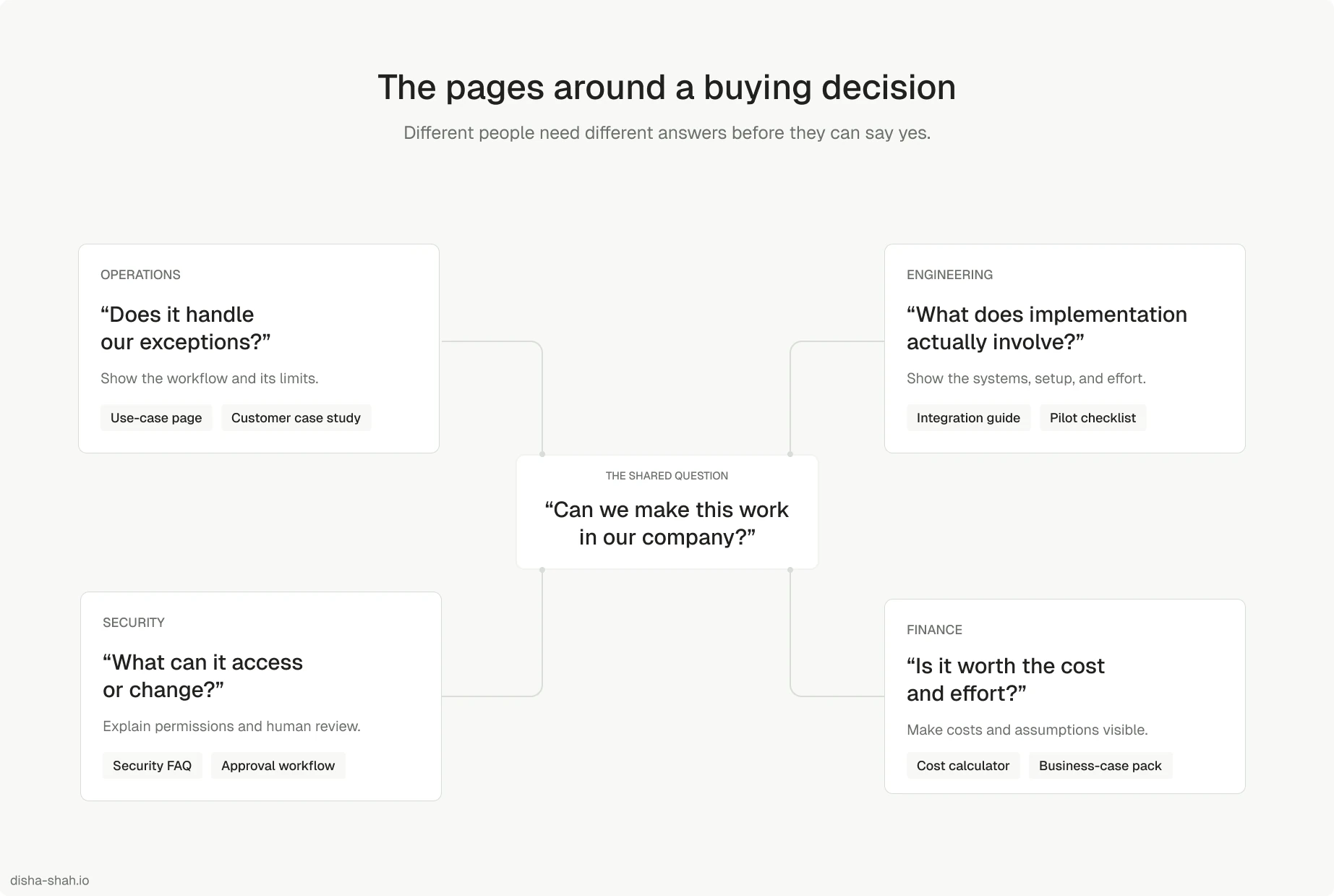
If people understand the product but keep asking how it works with their ERP, I’d prioritize the integration page. If they’re comparing us with the same two products, I’d work on those comparisons. If they like the idea but need proof, I’d spend time on a case study.
Competitor pages that help someone choose
For the GTM engineering example, a prospect might be deciding between several enrichment and automation tools, a custom workflow, and our product.
A useful comparison would follow the same task through each option.
An inbound account arrives. Its data is incomplete. The workflow needs to enrich it, check for an existing account, assign an owner, and write the result back to Salesforce.
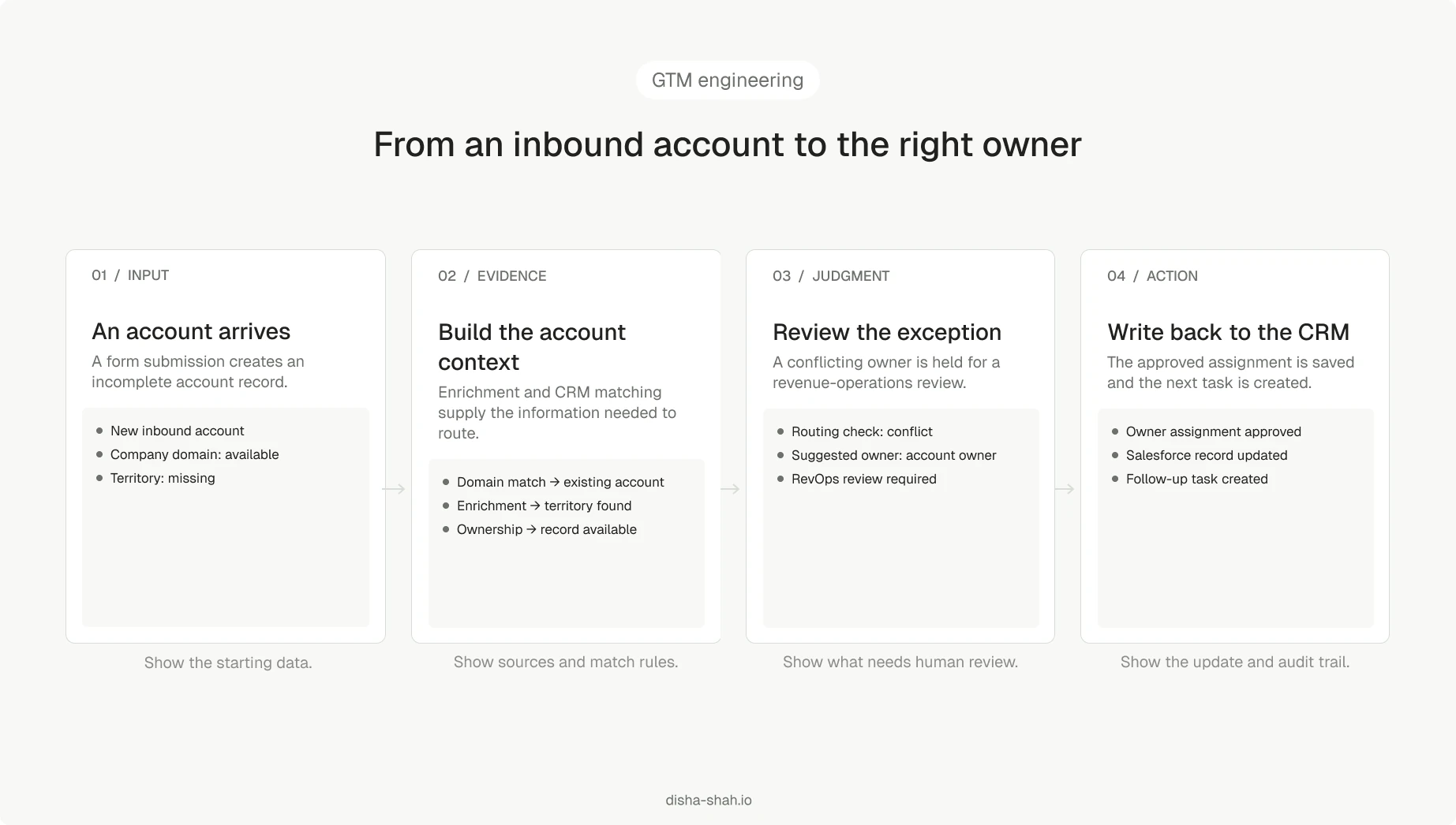
I’d compare setup, data sources, handling of conflicting information, maintenance, and cost assumptions. I’d show what happens when the workflow encounters an exception.
I’d also explain when the existing approach makes sense. A team with a mature custom setup may have different needs from one building its first routing workflow.
That gives a buyer something to assess beyond a feature grid where our product wins every row.
I’d start with a small set of relevant comparison queries and aim to answer them thoroughly. The page would need a clear testing method and an owner who keeps it current.
Integration pages that explain the work
An integration page deserves more than two logos and a paragraph about saving time.
For a supply chain product, an ERP integration page could follow a supplier delay through to its effect on production.
Which purchase-order information enters the product? How does it connect that information to materials and production orders? What does the planner review? Can an approved decision be written back to the ERP?
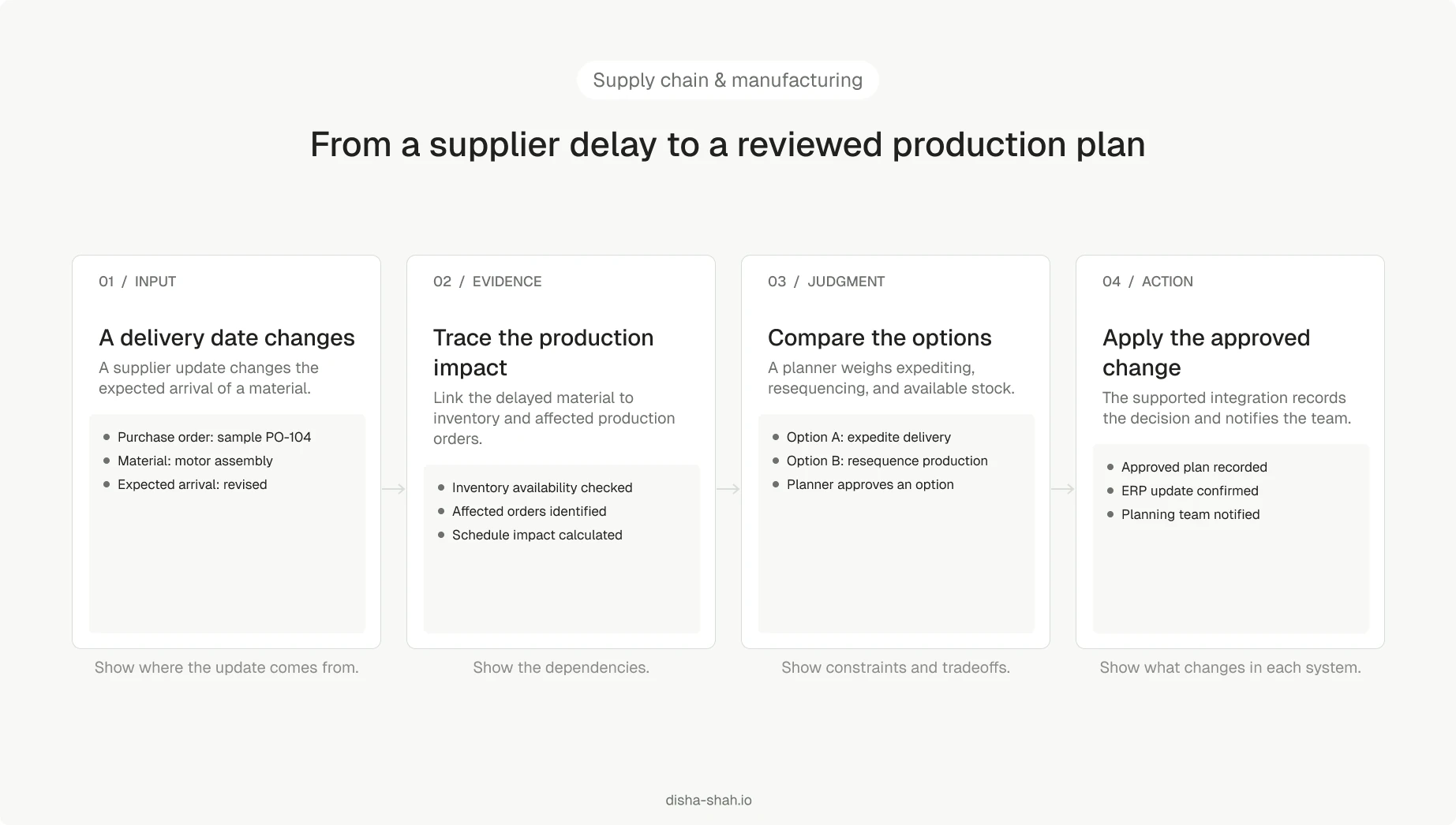
I’d show a sample workflow and distinguish what works today from what requires configuration or additional development.
Details such as required fields, permissions, synchronization frequency, and failure handling can help a buyer scope an evaluation.
They also make the product’s philosophy visible. If we believe planners should remain in control of operational decisions, the page should show where they review and approve a proposed change.
FAQs drawn from actual evaluations
I’d collect questions from sales calls, technical evaluations, onboarding, and support, then answer them where they arise.
For a healthcare operations product handling referral intake, those might include:
- How does the system identify missing documents?
- What happens when it cannot confidently interpret a field?
- What does staff review before information moves downstream?
- Which systems can it connect to?
- What access controls, retention settings, and audit records are available?
These answers need product and security review. I wouldn’t let a writer infer them from a general claim about being enterprise-ready.
A fictional sample referral packet could help demonstrate how incomplete information is flagged and handed to staff. The example should make the administrative workflow understandable without implying an unproven clinical outcome.
Resources and lead magnets I’d make room for
I’d choose a lead magnet based on what someone is trying to do next.
They might need to understand a problem, estimate its cost, compare solutions, test a workflow, or get approval from someone else.
| Type of lead magnet | Example | How I’d use it | What makes it worth using |
|---|---|---|---|
| Diagnostic or assessment | A workflow audit identifying manual reviews and recurring exceptions | Offer it alongside content explaining the problem | Gives a specific finding and a useful next step, with clear reasoning |
| Calculator | A workflow-cost calculator using volume, review time, and software costs | Place it on use-case, pricing, or business-case content | Uses editable assumptions and shows how the result is calculated |
| Template or workbook | A pilot planning workbook with scope, owners, baseline measures, and acceptance criteria | Help a prospect move from interest to planning | Includes a completed example and works without another call |
| Evaluation or benchmark kit | Sample inputs, test scenarios, and a scoring rubric | Support comparisons, demos, and technical evaluations | Lets the buyer test something meaningful and assess results consistently |
| Implementation kit | Field mappings, setup instructions, exception rules, and a rollout checklist | Offer it from integration pages and onboarding material | Reduces setup work and makes prerequisites clear |
| Decision or approval pack | An editable business case, stakeholder brief, and vendor-question checklist | Help an internal champion explain the purchase | Makes room for costs, risks, alternatives, and unanswered questions |
| Research or reference resource | An original benchmark report or documented collection of workflow examples | Support educational articles and outreach | Contains useful information with sources and methodology |
| Small interactive tool | A routing-rule tester or sample-data validator | Let someone complete a narrow task from a relevant landing page | Produces a useful result quickly and makes its limits clear |
| Case-study replication kit | The checklist, configuration, or template used in a documented customer workflow | Place it beside the case study | Helps the reader apply the example to their own situation |
A useful asset should save the reader some work.
For a calculator, that means sensible inputs and transparent assumptions. For a template, it means a completed version. For an evaluation kit, it means sample data and a clear way to assess the output.
For example, a cybersecurity investigation page could offer synthetic alerts, expected evidence, and a scoring sheet. A security team could use the pack to ask better questions during a demo or pilot.
I’d match the offer to the page. Someone reading a comparison may appreciate an evaluation scorecard. Someone looking at an integration may need a setup workbook. Someone seeking budget approval may need a business-case template.
I’d organize the resource library around those tasks, with substantial assets getting their own pages, previews, and instructions.
I wouldn’t gate everything. A calculator could show the result immediately and offer a saved copy. A template could have a full preview. A reference page could remain open, with an optional download.
Downloads would be one measure. I’d also ask whether the resource helped someone complete a task, prepare an evaluation, or start a useful conversation.
For this article, I’d create a stack calculator that accounts for tools the reader already pays for. Its output would be a specific shopping list, the additional cost, and what they can postpone.
Why I’d write about the product’s philosophy
A product page can explain what the software does. A philosophy article gives us room to explain why we built it that way.
For an AI enterprise product, those choices can matter during an evaluation. How much control does a person retain? What happens when information is incomplete? Can someone inspect or change a recommendation? What does the product deliberately leave to the user?
I’d write about a belief when it helps someone understand a concrete product decision.
For example, “analysts should be able to inspect the evidence behind an AI investigation” could explain why the product exposes sources, preserves an investigation history, and requires approval for certain actions.
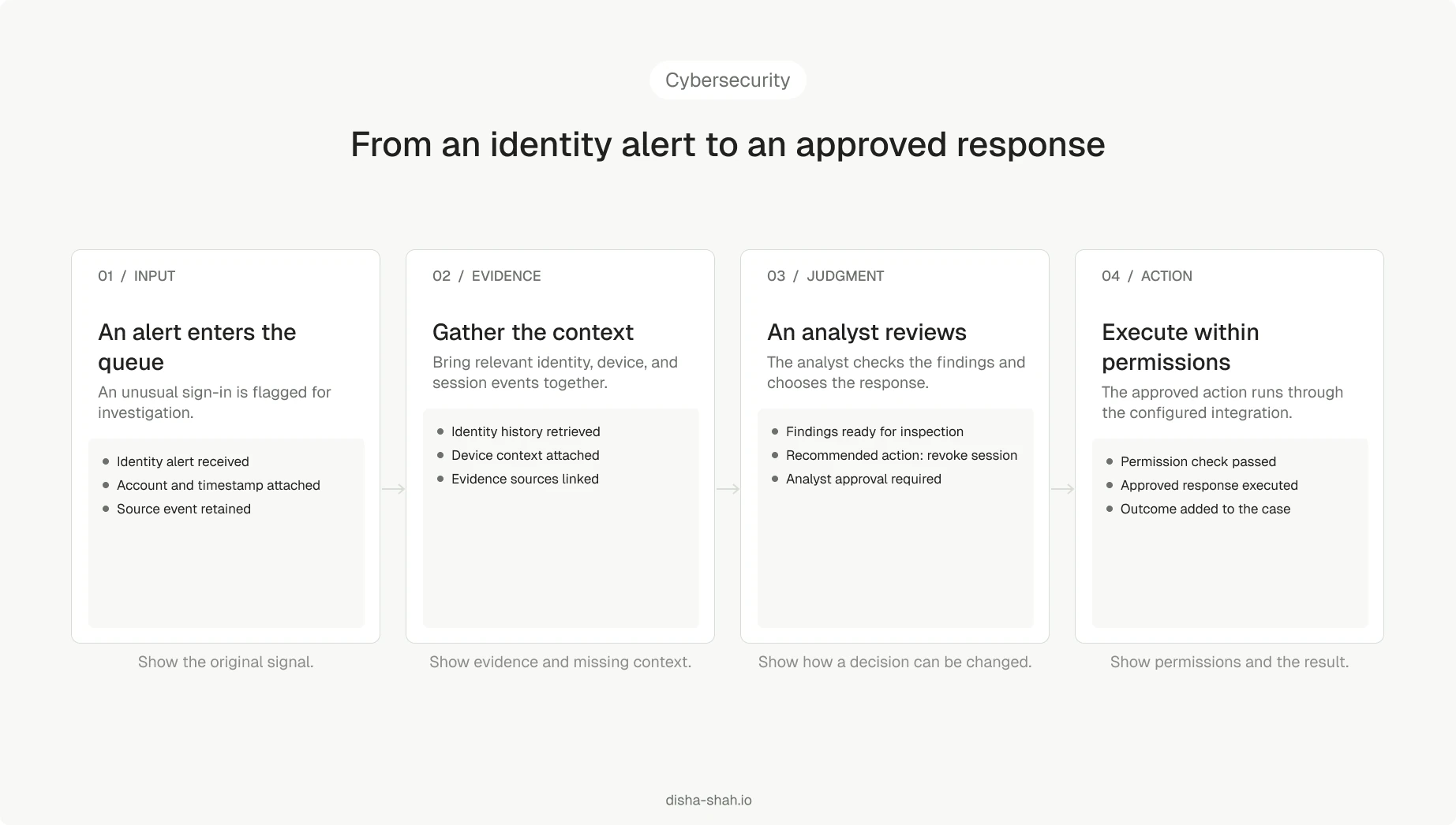
I’d want the article to do four things:
- Explain our tradeoffs. A buyer should understand why we chose an approach and what that choice means for them.
- Help the right customer recognize a fit. Someone who values review and control should see how those priorities appear in the workflow.
- Give an internal champion language they can reuse. They may need to explain the approach to an operations lead, security reviewer, or executive.
- Connect features to a consistent way of working. Integration pages, FAQs, and demos should make more sense after reading it.
I’d build the article around one belief, supported by three or four real cases.
The structure would be:
The problem we kept seeing → what we believe → the product decisions that followed → real examples → where the approach has limits.
Each case should show a different part of the argument. One might demonstrate how someone reviewed a recommendation. Another could show how incomplete information was handled. A third might explain why a user changed the proposed action.
I’d include the original situation, what the person did, and what happened, supported by an approved quote, artifact, or documented result.
If we don’t have that evidence, I’d write a narrower explanation of the design choices and gather cases over time.
I wouldn’t judge this article only by search traffic. I’d also look at whether prospects refer to it, whether sales uses it to answer recurring questions, and whether it helps buyers explain the product internally.
I’d publish it on the blog, share it through the founder’s channels, and link to it from the product pages where the underlying decision matters. From the article, I’d link to the workflows and cases it discusses.
What a week with this stack would look like
I’d keep the weekly process small, with one person responsible for moving the work forward.
| When | What we do | What we leave with |
|---|---|---|
| Monday, about 45 minutes | Review search data, customer questions, and priorities | One page to create or improve |
| Tuesday, about 60–90 minutes | Research the opportunity and gather evidence | A brief with a clear format and examples |
| Wednesday–Thursday | Write, build, test, and review | A published page or substantial update |
| Friday, about 30 minutes | Check links, tracking, and the release | An owner and a later review date |
Production needs its own time. An integration page requiring engineering review may take longer than improving an FAQ.
Suppose we’re working on the GTM product.
On Monday, we notice prospects keep asking how routing works when account data is incomplete. We check whether this also appears in search data and competitor content.
On Tuesday, we decide whether to improve the Salesforce integration page, create a focused use-case page, or add a resource to an existing page. We test the workflow with sample accounts.
During production, we document the routing logic, show an exception, and add the routing test pack. We make the next step specific: evaluate the workflow against your requirements or request a relevant demo.
On Friday, we check that the page and download work and that the next action is measured.
We schedule a later performance review. A newly published page won’t tell us much about search performance in its first few days.
With two people, I’d combine research and writing where practical. With a third, I’d assign the work that keeps getting delayed: testing, production, implementation, or distribution.
What I’d skip—and what would change my mind
I’d look at the subscription cost, the work it creates, and whether we can use the output.
Some tools are worth buying later. Some are already covered by something we own. Others might be useful for a specific project without needing a permanent subscription.
| What I’d hold off on | Why I’d wait | What I’d do for now | What would change my mind |
|---|---|---|---|
| A second broad SEO suite | We’d be paying for overlapping research before knowing what’s missing | Use one suite and record its limitations | A specific gap repeatedly affects decisions, and a trial confirms the second tool solves it |
| A higher plan or extra seats by default | A larger team doesn’t necessarily need more research access | Give access to researchers; share briefs and permitted exports | Limits interrupt planned work, or another person needs independent access |
| A separate content optimization tool | We may spend time improving a score without improving the page | Review search results, customer questions, evidence, and clarity | Briefing or reviewing becomes a recurring bottleneck, and the tool demonstrably helps |
| A dedicated AI visibility subscription | Mention tracking creates another stream of information to interpret | Define the questions we care about and record directional observations | We have a clear monitoring need, an owner, and a useful response to the findings |
| Custom dashboards and reporting integrations | Setup and maintenance can consume time before anyone uses the report | Keep a small shared report tied to decisions | Repeated reporting is expensive, or the current report cannot reliably answer important questions |
| Large-scale publishing automation | Review and maintenance work increase alongside output | Prove a small set of page formats and establish ownership | We have reliable source material, distinct pages worth creating, and maintenance capacity |
| A large technical audit with no implementation capacity | A long issue list doesn’t help if nobody can act on it | Scope an investigation around important pages or a known problem | Engineering time is allocated, a migration is coming, or evidence points to a wider issue |
| A library of lightly researched competitor pages | Weak comparisons can damage credibility and become outdated | Build the comparisons that recur in relevant evaluations | We can test the products and maintain the claims |
| A new lead magnet for every article | Each asset needs production, distribution, and upkeep | Build one strong resource supporting several related pages | Readers have a distinct need the existing resource doesn’t serve |
| More tools because results are slow | The issue could be targeting, execution, the offer, or the product experience | Investigate where progress stops | We can explain which missing capability is preventing useful work |
I’d revisit these decisions at renewal time. If we can’t point to useful work a tool supported, I’d consider downgrading, cancelling, or buying it only when a project needs it.
I wouldn’t cancel something solely because it gets used infrequently. A specialist tool used during a migration might earn its cost in that one project. I’d judge it against the job we bought it for.
Where I’d spend the next dollar
I’d identify what is holding the team back first. The next purchase could be software, but it could also be a few days of engineering, a customer interview, or help finishing a page.
| What we’re seeing | Where I’d spend next | What I’d want that spend to produce | What I’d check afterward |
|---|---|---|---|
| We have plenty of ideas but keep changing priorities | Customer research and a review of sales questions | A short, evidence-backed list of problems and pages | Can we explain who each page serves and why it matters now? |
| Good briefs sit unfinished | Writing, editing, design, or development help where the delay occurs | Finished priority pages with required reviews completed | Are we shipping useful work more consistently? |
| Our pages make the same claims as everyone else | Product testing, customer interviews, and permission to document examples | Demonstrations, workflows, and credible case material | Can we answer questions with evidence we stand behind? |
| Prospects understand the promise but can’t assess implementation | Technical documentation and solutions-engineering time | Integration walkthroughs, sample data, requirements, and limitations | Can buyers scope an evaluation with fewer unresolved questions? |
| Relevant visitors rarely take the next step | A review of the page, offer, and conversion path | A better-matched sample, evaluation kit, demo, or trial workflow | Do more suitable visitors take a meaningful next step? |
| Resources get downloaded but barely used | Usability improvements and conversations with downloaders | A clearer asset, completed example, or easier first task | Are people using it during their work or evaluation? |
| Important pages have technical problems | A scoped investigation and implementation time | Fixes to the crawling, indexing, rendering, or navigation issues found | Are the affected pages accessible and behaving as intended? |
| Research limits interrupt planned work | A higher plan, additional access, or a specialist source | Enough capacity for research we already know we need | Did the upgrade remove the interruption, and are we using it? |
| Useful pages rarely reach the right people | Relevant distribution and partnerships | Placement in partner resources, customer education, communities, or sales workflows | Are qualified readers finding and using the content? |
| Internal approval keeps stalling | Content built with sales, product, and security stakeholders | A business case, evaluation plan, security answers, or implementation brief | Can the internal champion move the conversation forward? |
| Existing pages are becoming inaccurate | Dedicated maintenance time | Updated comparisons, screenshots, integrations, and claims | Are priority pages accurate, and does each have an owner? |
I’d keep the first spend small enough to evaluate. Commission one well-scoped case study before committing to a series. Improve one integration page before rebuilding the directory. Test an upgraded plan against a month of planned research before taking on an annual commitment.
Some work needs immediate attention: broken product paths, inaccurate claims, or important pages search engines can’t access. For other investments, I’d weigh the importance of the page, the evidence behind the problem, and the team’s ability to finish the work.
My starting stack would still add about $129 a month under these assumptions. If it already tells us what to do next, I’d put the next dollar toward getting that work finished.